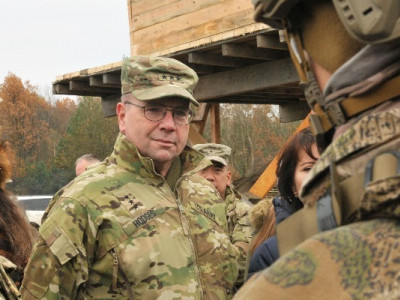
US Senator Blumenthal visits National Chornobyl Museum damaged by Russian attack

During the visit, the American delegation toured the exhibitions and reviewed materials about the accident at the Chornobyl Nuclear Power Plant, its consequences, and the courage of the people who helped eliminate the disaster's aftermath. Richard Blumenthal shared his impressions of what he saw and stressed the importance of preserving the truth about Chornobyl.
Photo source: Ministry of Internal Affairs
Oleksandr Tarasenko, director of the Department of Education, Science, and Sports at the Ministry of Internal Affairs, emphasized that the damage to the museum cannot be seen as an accidental consequence of the war. According to him, Russia deliberately attacks Ukraine's cultural heritage and the memory of Ukrainian nation.
Oleksandr Tarasenko noted that the National Chornobyl Museum is the largest state repository in Ukraine and the world of relics related to the Chornobyl disaster, its causes and consequences, as well as the heroism of those who responded to the accident at the Chornobyl Nuclear Power Plant. The museum falls under the authority of Ukraine's Ministry of Internal Affairs. It preserves the history of the largest man-made disaster of the 20th century and the memory of the people who protected others at the cost of their own lives and health.
The museum's restoration became one of the important cultural heritage preservation projects of Ukraine's Ministry of Internal Affairs. Restoration work and exhibition renewal began at the end of 2024, and the museum reopened in April 2026 after a large-scale restoration.
"The Ministry of Internal Affairs played a key role in stabilizing the museum's work. After the Russian attack, we faced a new task: to urgently save the museum's collection and property. The ministry immediately took the necessary measures, and search operations involving the State Emergency Service lasted six days. We managed to find most of the exhibits that were considered lost on the first day. This is extremely valuable for the museum, because the collection is its foundation. And today, our shared responsibility is not only to rebuild the walls, but to preserve the memory of the liquidators' heroism, the history of Ukraine, and pass it on to future generations," Vitalina Martynovska, director general of the National Chornobyl Museum, said.Photo source: Ministry of Internal Affairs
Background
The National Chornobyl Museum is an important cultural and representative institution of Ukraine that tells the story of the accident at the Chornobyl Nuclear Power Plant, the response to its consequences, and the people who lived through the tragedy. Its exhibition also reflects on modern challenges related to war and nuclear security.
For Ukraine, preserving the National Chornobyl Museum carries special significance. It is not only about restoring a building or an exhibition, but also about preserving the memory of one of the largest man-made disasters of the 20th century and the truth about Ukraine's experience in overcoming it.
The National Chornobyl Museum became one of the Ukrainian cultural heritage sites damaged as a result of Russian aggression. On the night of May 24, 2026, a Russian missile attack caused critical damage to the building. Museum staff and rescuers from the State Emergency Service managed to save a significant part of the exhibits.
The museum building is symbolically located in a former fire station. In 1986, firefighters and rescuers were among the first to arrive at the Chornobyl Nuclear Power Plant to eliminate the consequences of the accident. The museum opened in 1992, and its exhibition preserves the memory of more than 7,000 responders to the Chornobyl disaster.
The missile strike hit the museum one month after the opening of the renewed exhibition on April 26, 2026.
- Last
News by day
26 of August 2026