European Day of Remembrance for the Victims of Stalinism and Nazism

August 23 is a day to commemorate people who fell victim to the Stalinist and Nazi regimes. We explain why this particular date became a day of remembrance and why it matters
Some events have had a significant impact on the history of Europe: learn how the policies of the Nazi and Stalinist regimes, repression, deportations and territorial divisions affected the lives of millions of people and why their consequences can still be felt today.
On August 23, 1939, representatives of Nazi Germany and the Soviet Union signed a non-aggression pact in Moscow. It became known to history as the Molotov–Ribbentrop Pact.
At first glance, the agreement concerned neutrality between the two states. However, the pact also included a secret additional protocol. Its contents became known much later. It was in this protocol that Germany and the USSR determined which territories in Eastern Europe would fall within their respective spheres of influence.
Poland was to be divided between the two states along the Narew, Vistula and San rivers. Finland, Estonia and Latvia were placed within the Soviet sphere of influence. Lithuania was initially assigned to the German sphere but was later transferred to the USSR. Bessarabia also fell within the Soviet zone.
Only a week after the pact was signed, Germany invaded Poland. On September 17, Soviet troops entered Poland from the east. This marked the beginning of World War II.
Read also: Rashism = Fascism? What Is the Essence of the New Ideology?
Several years passed before August 23 became an official day of remembrance.
In 2008, the Prague Declaration was signed in Prague. Among its initiators were Václav Havel and Joachim Gauck. The authors of the document called on European countries to recognize the crimes of communist regimes in the same way as the crimes of the Nazi regime.
On September 23, 2008, the European Parliament proclaimed August 23 as the European Day of Remembrance for Victims of Totalitarian and Authoritarian Regimes.
In 2009, the OSCE also officially recognized the date as the Day of Remembrance for the Victims of Stalinism and Nazism.
The first official commemoration took place in Warsaw in 2011. At the time, Poland held the presidency of the European Union.
The most notorious crime of the Nazi regime was the Holocaust. During the years of Nazi persecution, around 6 million Jews were murdered. People were systematically killed in extermination camps, ghettos and other locations in the occupied territories.
At least 500,000 Roma and Sinti were victims of the Nazi genocide in occupied Europe. In Roma history, these persecutions are known as the Porajmos.
In the occupied territories of the Soviet Union, the Nazis also killed more than 17 million civilians.
Another large-scale crime of the 20th century was repression under the Soviet regime.
Millions of people passed through the Gulag system of forced-labor camps. Many died from hard labor, starvation, disease and brutal living conditions.
The Holodomor of 1932–1933 claimed, according to various estimates, between 4 and 7 million Ukrainian lives. The famine was artificially created by the Soviet authorities.
Dozens of peoples of the USSR also experienced forced deportations. Crimean Tatars, Chechens, Ingush, Kalmyks and residents of the Baltic countries were forcibly relocated to Siberia, Kazakhstan and Central Asia.
During the Great Terror of 1937–1938, hundreds of thousands of people were executed on the basis of fabricated criminal cases and accusations.
Behind the statistics are always real people. Sometimes a single personal story can help us understand the scale of what happened much better.
Anitsa Nandrish-Kudla was born in 1904 in the village of Mahala near Chernivtsi. In 1941, she and her three sons were deported to Siberia. She survived forced labor and harsh living conditions. She later wrote the memoir 20 Years in Siberia, which became one of the well-known testimonies of Stalinist repression.
Aurora Buzhenice was born in 1936. When she was only four years old, her family was deported to Siberia. She did not return home until she was ten. Her story was later recorded and featured by several television channels.
May 1944 was a tragic month for the Crimean Tatar people. People were deported en masse to Central Asia. They were allowed to take only a few days' worth of food with them. A significant number of those deported never returned to Crimea. Mass return became possible only toward the end of the Soviet period and after the collapse of the USSR.
Lidiya Pen was born during the forced relocation of her family from the city of Suchan to Kazakhstan. She spent her childhood in Karlag, one of the largest forced-labor camps in the USSR. That is why she calls the camp her homeland.
Personal testimonies remain an important part of Holocaust remembrance.
One Holocaust survivor is Marion Blumenthal Lazan. In 2026, she spoke at a UN commemorative event in New York. She shared memories of her childhood and the persecution her family experienced. “We children saw things that no one should ever have to see,” she said.
In 2026, the University of St. Thomas in the United States hosted the Portrait & Pixels exhibition. It presented 92 personal stories written by Jewish survivors and American military personnel.
There is also a separate day of remembrance for Roma murdered in Nazi camps. On the night of August 2–3, 1944, around 4,300 Roma from the Auschwitz-Birkenau camp were killed in gas chambers. Today, this date has become one of the symbols of remembrance of the genocide of the Roma people.
Don't want to miss important updates and useful articles? Subscribe to our weekly newsletter!
If we look at how the Soviet past is discussed in modern russia, some things are difficult to overlook.
Stalin has gradually returned to the public sphere. His image appears alongside military symbols, while the Soviet victory in World War II is increasingly used not only as a historical event but also as part of modern state propaganda.
This is particularly visible during Victory Day celebrations. The history of the war is presented in a way that draws a direct line from 1945 to the present. Russia is supposedly fighting Nazism again — only now in Ukraine.
This interpretation of history also has a practical consequence: it is used to justify the current war.
A telling example is the Gulag History Museum in Moscow. It was closed in 2024. On February 20, 2026, it became known that the museum would reopen, but under a new name, the “Museum of Memory.” The new space is planned to cover both the victims of the Soviet genocide and Nazi crimes.
Why does this matter? Because a museum is not simply a building with exhibits. What is displayed there and how it is presented can significantly shape how the past is perceived.
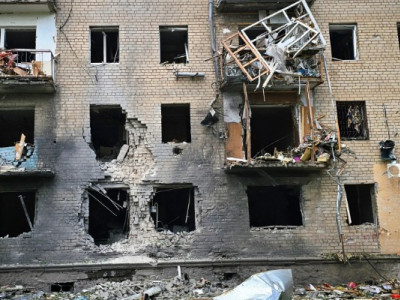
Now let us look at what is happening today. The United Nations has been recording civilian casualties in Ukraine since the beginning of the full-scale invasion on February 24, 2022. And the figures for the recent period show that the situation is not becoming less dangerous.
2025 was the deadliest year for civilians in Ukraine since the beginning of the full-scale war. A total of 2,514 people were killed and another 12,142 were injured. This was 31% more than the previous year.
The figures for July 2026 were even worse. In a single month, 437 civilians were killed and 2,610 people were injured. This was the highest monthly figure since March 2022. Compared with July 2025, the number of casualties increased by 70%.
During the first seven months of 2026, the UN recorded 1,830 civilian deaths and 10,638 injuries. For comparison, the figures for the same period in 2025 were 44% lower.
There is also an overall figure since the beginning of the full-scale invasion. The UN has confirmed the deaths of at least 16,874 civilians, including 820 children. Another 51,173 people were injured, including 3,126 children.
Attacks on energy infrastructure add to this. During the winter of 2025–2026, they regularly caused large-scale power outages across Ukraine. For civilians, this meant not simply a lack of electricity but a serious deterioration in everyday living conditions.
This raises another question: how should the modern russian regime be described?
Some researchers use the term “neo-totalitarianism.” It refers to a system that combines familiar characteristics of a totalitarian state — control, repression and propaganda — with modern methods of influencing society.
There is another parallel as well. Eastern European researchers compare Kremlin rhetoric with the way the regimes of Mussolini and Hitler once spoke. This includes the cult of the state, justification of war, nationalist rhetoric, and attempts to revise history and borders.
This is particularly evident in relation to Ukraine.
Russian state media and government officials have repeatedly made statements about the need to destroy Ukraine and Ukrainian statehood. Direct calls for violence against Ukrainians have also appeared in the public sphere.
Therefore, discussions of historical parallels are not limited to the past. Some mechanisms familiar from the 20th century are being used again in the 21st century.
What can you do on August 23? There are actually many options, and there is no need to organize a large-scale event.
If you work at a school, university, library or civic organization, you can hold a lecture or discussion about totalitarian regimes and their victims.
You can watch a documentary together or invite eyewitnesses or their descendants. If that is not possible, you can collect memoirs, photographs and archival documents and turn them into a small online exhibition.
Sometimes one person's story is remembered much better than dozens of figures in a textbook.
At 12:00 local time, you can observe a minute of silence.
Another simple option is to visit a memorial, light a candle or lay flowers. It could be a monument to victims of repression, the Holocaust or the Holodomor. A la
- Last
- August, 23
-
-
-
-
-
-
-
-
-
-
-
-
-
- August, 22
-
-
-
-
-
-
News by day
24 of August 2026