"I'm the boss": What Ukraine gained at the G7 summit and how Trump changed his stance

Donald Trump arrived late at a G7 working session in Évian, looked around the table and announced: "I’m the boss."
It’s the summit’s most candid description of its internal order.
France had spent months preparing the G7 around global economic imbalances, critical minerals, artificial intelligence and the gathering conflict around the Strait of Hormuz.
Ukraine was never certain to dominate an agenda crowded by Iran, China and a fraying global economy. Yet by the end of the summit, the seven leaders had adopted a dedicated declaration on Ukraine. It promised more air defence, more interceptors, long-range capabilities, support for Ukraine’s energy system and stronger sanctions on Russia’s oil and gas sectors.
The fact that the United States signed it was the point.
A year earlier, the G7 summit in Canada had ended without a common position on Ukraine after Trump left early. In Évian, he stayed until the end. He met Volodymyr Zelenskyy twice on the margins of the summit. Emmanuel Macron emerged declaring a "re-synchronisation" of the G7 on Ukraine and a "very deep change" in the American approach to the war.
The United States remains the country that can alter the military balance faster than any other partner, whether through its air-defence stockpiles, intelligence, industrial capacity or political influence over allies.
According to IMF-based figures assembled for the French presidency’s policy ecosystem, the group’s share of global GDP has fallen from roughly 60% in 1980 to about 45% in 2025. At the same time, power inside the G7 has become more lopsided.
The United States accounted for nearly 59% of the G7’s GDP in 2023, up from 46% in 2000. Europe may still speak in the plural; economically and militarily, America increasingly arrives as the heavyweight.
The G7 declaration contains more than ceremonial language. It says the group will increase deliveries of air-defence capacities, additional systems and interceptors, as well as long-range capabilities. It says members are ready to consider granting licences that would allow Ukraine to expand its military production. It promises further support for Ukrainian energy resilience ahead of next winter and stronger pressure on the Russian war economy.
Those commitments gather several strands of the war into one political offer. Air defence protects cities and industry. Long-range capabilities shape Russia’s calculations behind the front line. Energy resilience keeps the country functioning through winter. Industrial licences could reduce Ukraine’s dependence on the increasingly depleted arsenals of its partners.
Macron’s argument was that the G7 had finally accepted a reality that Kyiv has been repeating for months: Russia is not negotiating seriously because it believes time still favours it.
Trump, according to the French president, now shares that judgement.
The change should not be exaggerated. Trump’s position has moved before. It can move again. His administration remains an unpredictable presence in the coalition supporting Ukraine, capable of announcing a new posture one week and undermining it the next.
But diplomacy often begins with narrower gains. France did not obtain an American conversion to European strategic thinking. It obtained something more immediate: a US signature under a text that treat Russia as the problem, Ukraine as a partner worth arming, and pressure on Moscow as unfinished business.
That is a considerable improvement on the atmosphere of the previous G7 summit.
It also reveals how low the bar has fallen. European leaders now count it as a strategic success when the American president stays in the room, endorses a collective line and does not leave them to explain the consequences alone.
The G7 "agrees to increase" deliveries of air-defence capabilities and long-range systems. It is "ready to consider" licences for Ukrainian military production. It "agrees to provide further support" to get Ukraine through winter.
The declaration offers political direction, not operational detail. It gives no figures for additional systems or interceptors. It sets no timetable. It does not say which country will provide which capability, how licences would be structured, or what financing would make production viable in Ukraine.
For a country facing another season of Russian missile and drone attacks, that distinction is severe. An interceptor arrives in one of two forms: it is either in a warehouse, on a launcher or already flying towards its target. It cannot be substituted by a paragraph agreed beside Lake Geneva.
The same caution applies to military production. Friedrich Merz, the German chancellor, was right to say that Europe and the United States are producing too little, and that licences could help compensate for the shortfall. Ukraine has factories, engineers, experience and a brutal understanding of what works in modern warfare. Yet "ready to consider" is not the same as a signed industrial agreement. American firms have commercial interests, export controls and concerns about intellectual property. European governments have their own procurement rules and political constraints.
The United States and Europe have spent years sending weapons from existing stocks. That approach has limits. The next phase must involve production lines, shared designs, repair facilities and long-term orders. Ukraine should not remain a customer waiting for deliveries from abroad. It should become part of the industrial base producing the weapons Europe itself will need.
Évian acknowledged that possibility. It did not settle it.
The summit did not establish a security-guarantee mechanism for Ukraine. The EU and its member states said they were prepared to contribute to "robust and credible security guarantees" for Ukraine through the Coalition of the Willing and "in cooperation with the United States".
Europe wants to prepare for a future in which it it carries more responsibility for its own security. Yet the guarantees it is beginning to sketch still depend on cooperation with the same country whose commitment has become hardest to predict.
There is no contradiction in wanting American involvement.
Europe cannot replace the United States overnight.
It still relies on American intelligence, surveillance, strategic lift, nuclear deterrence and several categories of advanced weapons. But dependence becomes dangerous when the partner at its centre changes policy according to personal instinct, domestic politics or the latest crisis.
Trump’s "I’m the boss" line was delivered as a joke. It nevertheless captured the bind facing European capitals. They dislike his methods, distrust his consistency and understand that he can use their dependence as leverage. They also know that the United States remains indispensable in the short term.
France’s policy in Évian was built around that uncomfortable reality.
Macron’s version of strategic autonomy is often described as an effort to free Europe from America. The summit showed a more practical version. France is not trying to push Washington out of European security. It is trying to keep Washington involved while Europe builds enough capacity to survive a future American retreat.
The French achievement at Évian was therefore not autonomy. It was time.
Time for Europe to increase military production. Time to build a more credible air-defence architecture. Time to turn Ukrainian and European defence industries into partners rather than occasional contractors. Time to reduce the risk that a political mood swing in Washington leaves a hole in Ukraine’s defence.
The European Council has called for faster production and delivery of air-defence systems, ammunition, drones and missiles. It has also linked Ukraine’s security to the protection of energy infrastructure, the repair of the grid and the resilience of civilian life. On finance, the EU has far stronger instruments. Brussels expects the first disbursement from its €90bn loan for Ukraine in 2026 and 2027 before the end of June.
Europe can keep the Ukrainian state functioning. It can finance reconstruction, support reform and move accession negotiations forward. It has proved that repeatedly.
Its weaker point remains hard power. A Europe able to fund recovery but unable to secure Ukrainian skies without American help has not yet achieved strategic autonomy. It has achieved a partial form of it.
Ukraine, meanwhile, is not only the recipient of European security policy. It is becoming one of its architects. Ukrainian forces have adapted faster than most European militaries to drones, electronic warfare,, dispersed production, civilian resilience and the industrial demands of a high-intensity war. European armies are studying those lessons because they have little choice.
The war has already made Ukraine central to Europe’s future security order. The question is whether Europe will treat Ukraine as a temporary battlefield on its eastern edge or as a permanent military and industrial partner.
The licensing debate points towards the second option. So does the growing recognition that Ukrainian factories should not merely repair foreign systems but help produce the next generation of European capabilities.
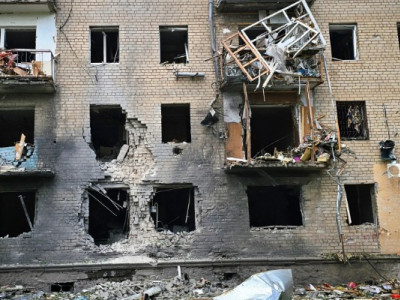
The first test is air defence. Ukraine needs additional systems and interceptors before Russia’s next major campaign against cities and energy infrastructure. Every delay will be measured in damaged substations, destroyed housing and civilians spending nights in shelters.
The second is industrial. Announcements about licences must lead to contracts, technology transfer and production. Otherwise, Europe will continue to describe Ukraine as a defence-industrial partner while leaving its factories dependent on decisions made elsewhere.
The third is sanctions. The G7 promised stronger pressure on Russian oil and gas.
The European Council went further, calling for reduced Russian energy revenues, tighter action against the shadow fleet, greater pressure on the banking system and more
- Last
-
-
-
-
-
-
-
-
-
-
-
-
- June, 23
-
-
-
-
-
-
-
News by day
24 of June 2026