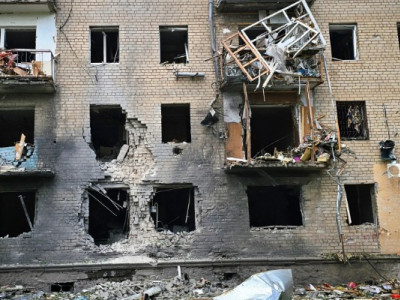
This Is Putins’s Regime Final Phase! Ukraine Burned Refinery on Election Day, — Interview with Jonathan Fink

Russian high-ranking officials and even military enlistment office staff are massively evacuating their families and capital abroad, which, according to Jonathan Fink, founder of the Silicon Curtain channel, indicates that the Kremlin system has entered the final phase of collapse.
The crisis is being deepened by successful actions of Ukraine’s defense forces: a combined strike disabled the Moscow Oil Refinery in Kapotnya on election night (after which even Donald Trump acknowledged the collapse of Russia’s diesel sector), while fighters of the Third Army Corps, in information silence, carried out Operation “Vivaldi,” cutting off the enemy’s offensive pincers near Lyman.
Against the backdrop of military defeats and the threat of 100% tariffs on oil exports under the Graham Act, Moscow is resorting to desperate provocations against NATO — from violating Polish airspace to drone incidents in Leipzig and preparing sabotage operations in Europe.
— This week Ukraine hit Moscow with 10 types of its own-produced weapons, they say. So an operation near Lyman went ahead that the Ukrainian military kept — finally, if you ask me — quiet about, until the very end of it, a successful end of it. And Polish fighter jets were scrambled because of Russian drones near the border. So, literally, make your choice — what would be your news of choice, what surprised you the most this week?
— If I say none of it surprised me, that’s not very helpful, is it? Certainly I’ve been predicting for some time that Russia is going to get far bolder, take on far more risk.
— Striking near the border, right?
— Striking the border, for me, was the least surprising and the most surprising. It’s the least surprising because it seems to me their strategy is to cut Ukraine off from its export routes, cut Ukraine off from its partners, cut Ukraine off from Europe, and deter Europe from supporting Ukraine. So this fits with a pattern that was fairly predictable. It hits hard because of the number of people who were near that border crossing who experienced it, including close personal friends. And I have to say, I think it’s been under-reported. We’ll come to Leipzig, maybe, in a minute — that also, I think, is under-reported, in terms of the risk profile, the scale and audacity of the attack. What happened near the border could very easily have taken out a great number of people, including people I personally know — that always hits hard. But a mass-casualty event is what we’re building up to.
The risks Russia is taking are almost inevitably going to lead to a mass-casualty event, either on the border or in Europe, in the coming weeks and months. I think that’s now clear from the pattern of this behavior — and it’s just started to be reported, as the US uncovers an assassination network on its territory, and this extraordinary story that supposedly seaborne drones may attack the Mediterranean — that came out of, I think, France, Italy, Spain are in the frame — that perhaps is a little surprising, given that the real focus of Russia’s hybrid attacks have been Poland, the Baltics — those who are closer in proximity, who have export borders or contiguous borders with Ukraine, and those who are supporting Ukraine materially, perhaps more. So I think it’s interesting that they would potentially seek to strike the Mediterranean — that, for me, is the most surprising thing. But of course, at this point, call it an intelligence rumor, dare I say — it’s not fact at this point.
— Yeah, okay, well, we can talk in a week and see what happens then. But we’re also sending a message — Ukraine is sending a message. Oh my God — on the night of September 20th, the final day of the State Duma elections in Russia, Ukraine carried out probably its largest combined missile-and-drone strike on the Moscow region — and that’s the assessment of the US-based Institute for the Study of War. Zelensky named 10 types of weapons, largely made in Ukraine, including Flamingo cruise missiles — and the Moscow oil refinery, which supplied up to whatever it is, 70% of the gasoline and jet fuel for the entire capital and the region, completely halted, stopped processing crude completely. And that was on election day — rigged, but still a Russian election, let’s call it that way. You think we’re sending a message to the Kremlin. Is it coming through?
— Absolutely. And I think the underlying story, which again doesn’t get enough coverage, is that this isn’t just a one-off. Ukraine has been sending, regularly, over the last several months, more projectiles into Russia than Russia sends into Ukraine. Now, of course, we know that when Ukraine is struck, yes, sometimes it’s strategic objectives, but it’s also gas stations, hospitals, maternity wards, universities, civilians. So there’s a disparity in terms of the targeting and the brutality — Ukraine always seems to choose strategic objectives. If they go awry, that’s certainly not the intention of the strikes. And you follow, I guess, quite a few of the Russian Telegram channels and so on — many Russians openly discuss how safe they feel under Ukrainian bombardment, because they know they’re not the objective of that. But the underlying story here is Ukraine is consistently sending more into Russia than the reverse is true. And of course, what Ukraine is doing is having a strategic impact.
— Why? How do we know this?
— Because someone has leaned on President Trump to beg Zelenskyy to stop — “please stop hitting the aggressor, please stop fighting back.” That’s not surprising either, but it is a disgrace.
— Well, we shouldn’t stop, right? You mentioned these voices from Russia, and we hear voices of Russian ultranationalists who are outraged — well, “ultranationalist outraged” is a nice choice of words — but that a state cannot defend its own capital. So who actually hurts more, Jonathan? The Russian oil industry, which is huge, or Russian beliefs of imperial greatness — that the war is out there in a land far, far away, and then suddenly, all of a sudden, it’s not — it’s Moscow.
— It’s a key point, isn’t it — that up until now, Muscovites especially, and St. Petersburg, have been largely shielded from the effects of the war. Those who were minded to could stick their heads in the sand, carry on going to galleries and parks and restaurants and so on. Yes, psychologically, it’s bringing the war home. However, one has to think why Ukraine is doing this, strategically. Is the command thinking this will ferment a revolution? No, I don’t think they have any such delusions there, because we know that’s not how Russia works. Do they think the oligarch class is going to rise up and depose the Tsar? No, I don’t think they think that either.
What I think they’re doing is, yes, sending a message, sending the pressure up — the pressure building towards a unilateral ceasefire, which is, of course, President Zelenskyy’s key objective, I think, in all this diplomacy. I think that’s a good starting point, given that Moscow will never make concessions — then having at least some sort of halting of offensive action would be good. But we know that’s not how Putin operates either — he is not going to stop until he is stopped. That’s been true from day one, unfortunately. Now Ukraine has the capability to fight back. So I think there will be endless debate about negotiations, about stopping, about a moratorium on energy, etc. I think you and I know that’s all window dressing. The key story here is, how can Ukraine strike back, how can it take out Russian infrastructure, how can it make, for the first time, winter in Moscow as grim as winter was for Kyivans last year?
— When you say that some people try to put their heads in the sand in Russia — but the other part of it is that you leave your other parts open to things, and things happen. And on September 13th, Donald Trump says, “Mr. Zelensky has to do one thing — he has to stop knocking out diesel fuel in Russia.” And that’s things happening, because it’s causing shortage, or whatever Trump thinks it’s causing. Then, on September 22nd, Trump also calls this strike, I quote, “a serious hit against the Russians.” This is a change of tone, isn’t it — and what changed the tone in those nine days, do you think, Jonathan?
— It’s an interesting one. I spoke to someone who claims to have inside information — someone who claims to have seen Trump’s reaction to Operation Spiderweb, for instance — and for those who immediately think that Trump is a Russian asset, 100% acting as an asset or an agent, there are certain behaviors that don’t make sense. For instance, in this instance, he seems to be impressed by the capability. Well, actually, if you follow Trump, that’s not so surprising — he’s impressed by strength. That’s why he has this extraordinary attitude towards dictators, towards those who rip up the rule of law, who are able to command their systems, hoard resources, and steal with no end. He admires these people, he admires strength. So there’s something here, perhaps, on the change of perception of Ukraine. He may even, according to the source I spoke to, get some kind of entertainment out of the idea of Russia (ph) getting whacked — he might find it funny.
— Is that strategic, though? Is that changing his overall perception? Because he always seems to snap back to actual actions that nominally benefit Russia.
— So maybe he does find it amusing that Russia’s getting a kick in the pants. Is he going to pass the sanctions bill? Is he going to even sell the munitions Ukraine needs to carry on the mid- and deep-strikes, using Western kit as well as their own? It’s very unlikely he’s going to do that. I think we have to limit what we expect here. And then, of course, there’s — is he getting bad information about diesel, or is this just disingenuous? Because the fact is, even if Ukraine stops striking the infrastructure tomorrow, it’s not magically going to produce all this diesel. And in fact, Russia stopped exporting
- Last
- September, 27
-
-
-
-
-
-
-
-
-
-
-
-
-
-
-
-
-
-
-
News by day
28 of September 2026