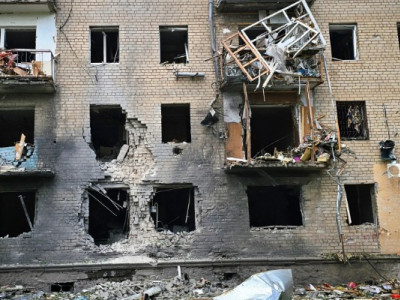
Ukraine’s War Risk Insurance Market: What Travelers Need to Know

Discover how Ukraine’s war risk insurance market is changing and what the changes mean for travelers and policyholders.
Ukraine’s war risk insurance market is changing as claims and reserves grow. Discover what the latest figures mean for travelers and policyholders.
Ukraine’s insurance market is continuing to adapt to the financial consequences of the war. New figures from the National Association of Insurers of Ukraine (NASU) show that insurers paid UAH 176.5 million in war-risk compensation during the first half of 2026, while reserves for reported losses that had not yet been fully paid reached approximately UAH 977 million.
The figures provide a clearer picture of how war risk insurance operates in Ukraine as attacks continue to generate claims and insurers take on new categories of risks. At the same time, the market is expanding beyond traditional property coverage, with insurers increasingly working with renewable energy facilities, cargo, corporate assets and other risks. For travelers and foreign citizens visiting Ukraine, the broader market developments raise a practical question: do these changes affect an existing Visit Ukraine policy?
No. If you already hold an active Visit Ukraine povlicy, nothing changes for you during its current term. Your coverage and conditions remain the same for the entire period stated in your policy. Changes in the wider insurance market do not alter the terms of an already active policy.
Read also: Why You Need War Risk Insurance Even for Short-Terms Visits to Ukraine
What the latest numbers say about war risk insurance in Ukraine
NASU's review covers the first half of 2026 and is based on reporting from 17 insurance companies. The data shows that war risk insurance has developed into a separate financial mechanism within the Ukrainian market, with insurers paying compensation for actual losses and gradually extending coverage to additional categories of property and business activity. During January to June 2026, insurers paid UAH 176.5 million in war-risk compensation.
The distribution between the two quarters was particularly uneven: payments amounted to UAH 47.1 million in the first quarter and increased to UAH 129.4 million in April to June. That difference illustrates how quickly claims activity can change following a series of attacks. Even when the number of active insurance contracts remains relatively stable, individual attacks can produce a sharp increase in reported losses and completed payments.
Read also: War Risk Insurance for Complex Trips Across Ukraine: What Policy You Need
The insurance market itself also operates under the same conditions as the businesses and individuals it serves. Ukrainian insurers have offices and branches in the same cities as their policyholders, meaning their own infrastructure can also be damaged by attacks. At the same time, they have to maintain sufficient capital, establish reserves and process compensation for customers who have suffered losses.
For businesses with substantial physical assets, insurance compensation can provide funds for repairing property, restoring operations or replacing damaged equipment. Transferring part of the financial consequences of a war-related event to an insurer can also affect a company's ability to resume operations after an attack.
The basic categories of war-related events accepted for insurance have remained broadly similar since 2022. Depending on the contract, coverage can include direct hits by missiles or attack drones, falling debris and damage caused by the operation of air defense systems. Related consequences can also be included, such as fires, explosions and damage caused by blast waves.
The market has nevertheless been expanding into new areas. During the first half of 2026, insurers recorded war-risk coverage within liability insurance and financial risk insurance for the first time. Life insurers are also including war risks more frequently in savings programs. The number of new contracts of this type exceeded 5,000 during the reporting period. Cargo insurance has become another distinct area.
According to the NASU data, an insurer's responsibility may continue during temporary storage or transshipment for up to 45 days, rather than applying only while goods are physically moving. This matters for international supply chains because cargo can change vehicles several times or remain temporarily in a warehouse before continuing its journey. The war-related exposure remains while the goods are waiting, so gaps between separate stages of insurance protection could leave the owner carrying the entire risk during those periods.
Choose a proper insurance plan with war risk coverage at Visit Ukraine now. Protect your entire stay!
Renewable energy has also become a more active segment for insurers. Companies are increasingly working with solar power plants, wind farms and industrial battery energy storage systems (BESS). These facilities have a specific risk profile because a large proportion of their value can be concentrated in expensive equipment. Damage to individual components can stop generation or require a lengthy replacement process. For insurers, evaluating such risks requires an assessment of the facility's location, physical protection and potential maximum loss.
The UAH 176.5 million paid during the first half of 2026 represents claims that have already gone through the relevant stages of settlement. Another figure provides a broader view of the market's outstanding obligations. During the first half of the year, Ukrainian insurers reported approximately UAH 977 million in reserves for reported losses that had not yet been fully paid.
Of this amount, UAH 898 million related to damaged property, including apartments, warehouses and commercial premises, while UAH 28 million related to cargo. These reserves represent insurance events that have already occurred and been reported to insurers, while the corresponding payments had not been completed in full as of the reporting date. The difference between completed payments and outstanding reserves helps explain why looking only at money already paid can give an incomplete picture of the market.
Large property claims often require time for documentation, damage assessment and agreement on the compensation amount. Corporate claims can take considerably longer than standard retail cases, especially when the insured property involves large buildings, production facilities or complex equipment.
Don't want to miss important updates and useful articles? Subscribe to our weekly newsletter!
For policyholders, the figures also show why insurance compensation should be viewed within the claims process rather than as an immediate payment following an incident. The time required to assess a loss depends on the circumstances and the scale of the damaged property.
The cost of coverage remains one of the main barriers for large businesses. War risks require substantial capital, while international reinsurance capacity for Ukraine remains limited. According to NASU, the average premium for a corporate contract requiring an individual risk assessment was approximately UAH 3.3 million.
Each contract is priced separately according to the characteristics of the insured property, the requested liability limit and the particular war-related events the insurer agrees to cover. State compensation has had a noticeable effect on this segment. Under the relevant state program, businesses can, subject to established conditions, effectively pay 1% of the insurance premium.
The number of corporate contracts involving individual risk assessment increased from 99 at the end of the first quarter to 228 by the end of June. That means the number more than doubled within one quarter. For a large company, the premium has to be considered against the potential financial consequences of a major loss.
The cost of rebuilding a large warehouse, production line or substantial cargo shipment can reach hundreds of millions of hryvnias. The economic value of a particular insurance program depends on several elements, including the premium, deductible, liability limit and potential maximum loss.
The NASU statistics primarily describe the Ukrainian insurance market and its corporate and property segments. Travelers face a different set of insurance needs, particularly when they want protection against the consequences of passive war risks during their stay in Ukraine. Visit Ukraine currently offers several war-risk insurance options designed for people who are in Ukraine during the period of martial law or who travel to areas with an elevated level of risk.
For example, Armor 30,000 EUR provides coverage of up to EUR 30,000 for medical assistance and COVID-19 treatment, with a zero deductible. The policy also includes compensation for consequences of passive war risks, including accidental death, penetrating head or brain injuries, loss of sight or hearing, fractures and serious limb injuries, and different degrees of concussion. The current price is EUR 4.40 per day with the stated discount.
If you are planning a trip to Ukraine, explore Visit Ukraine's war risk insurance options and choose coverage that corresponds to your planned stay and needs.
Another option, Armor 100,000 UAH, has a zero deductible and provides financial protection connected with passive war risks. Its current coverage includes medical assistance and treatment, accidental death, concussions, penetrating head injuries involving brain damage, serious limb injuries, loss of sight or hearing and complete spinal cord rupture.
The current discounted price is EUR 3.56 per day. The product information states that both Armor 30,000 EUR and Armor 100,000 UAH are available to foreign citizens temporarily staying in Ukraine as well as Ukrainian residents.
For people who need annual coverage, Visa Insurance Armor+ provides annual coverage with a stated insurance amount of EUR 30,000 and zero deductible. Its cu
- Last
News by day
20 of August 2026