Putin “Captured” Sviatohirsk But Lost Soldiers: How Russian Generals Lie to Him, — Interview with Georgijs Ivanovs (@UkraineMatters)

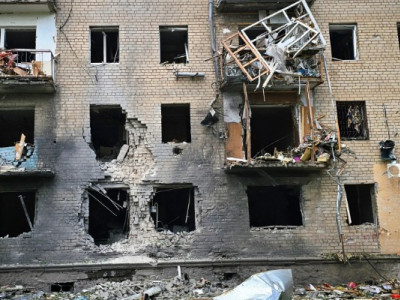
Ukrainian forces carried out a successful operation near Lyman, reclaiming more than 200 square kilometres while Russian propaganda continued to claim that Russia’s army was supposedly “advancing.”
In an interview with UATV, @UkraineMatters creator Georgijs Ivanovs analyses the situation on the frontline, the problems facing the Russian army and economy, the consequences of Ukrainian strikes on Russia’s oil-refining industry, and the occupiers’ enormous losses.
Why does the Kremlin conceal its failures? How are Ukrainian drones changing the war? And why should Europe adopt Ukraine’s battlefield experience more quickly? These questions are discussed in the interview.
— Let’s start with the thing that just wouldn’t leave the back of my mind. Let’s start with Lyman. So, on September 1st, Putin said — this is just a small town, I’ve been there — that a point 15 kilometers northwest of Lyman was under Russian control. On September 7th, a Ukrainian brigadier general posts a video — we all saw it, filmed in the center of this town. So Kremlin-linked military bloggers then admitted, on their own, that there had never been credible evidence of the capture of this town — that only doctored footage, supposedly from the town, had been circulating in the Russian segment of the internet. You read that segment every day, I suppose — how do you answer this for yourself? Is Putin being lied to by his subordinates, or is he just cherry-picking, while completely aware of the real situation?
— It’s a question that’s been asked for many, many months now — whether Putin understands and knows what he’s saying is untrue. There’s a lot of data that suggests he does know the situation is bad, but he also feels that he’s trapped in this war loop. I do believe he does know — but the projection he’s making is that everything is fine, that he cannot really step away from this. He is now, as President Zelensky said, a slave to this whole war effort. He cannot really admit that he’s losing — what would that be like? So for him, he must say that we’re always going forward, we’re always winning, we’re always capturing something.
And it’s important to understand that while this war is critical for everyone inside Ukraine, and critical for some people here in Europe and the United States who follow it, there’s a lot of people who don’t follow this war, right? Starting with a lot of the Russian population, who just know it on a very surface level — for them, Putin saying, “Hey, we’re advancing,” so, everything is good. And there’s a lot of Western politicians and people here who don’t follow the events — they hear, “Oh, Putin says they’re capturing stuff, they’re approaching stuff, it’s good” — they will never see video from Kyiv, but they will see video from Putin.
— Okay, well, yes, I agree — don’t get me wrong, I’m trying to play devil’s advocate here, as usual, that’s what I do with my guests. So, Ukrainian forces cut off the Russian salient north of Lyman, and this is huge — this speaks volumes — and took back more than 200 kilometers.
The operation began on May 22nd, if I’m not mistaken, ran for four months, in full secrecy — finally Russian military channels only started talking about the problems they call “near Lyman” in the past few days, maybe a week. How does a four-month operation go unnoticed, both by the Russian segment and the Western media — a lot of whom are following this war?
— I think you’re giving a little bit too much credit to Western media. There came an article recently — I believe from CNN, or something — and it was absolutely baffling to me, or to anyone else following the war, how you could have such a shallow, misunderstood analysis, saying that suddenly Ukraine is now losing ground, Russia is advancing, that Ukraine was supposedly on the offensive earlier this year and is now being more defensive — which, anyone who’s spent even one day looking into what’s actually happening would understand is not the case. So there obviously are certain specialized media outlets following the war, following the noticeable analysts, but for a lot of people, this is still a very surface-level overview of what’s actually happening.
— Right, and I must admit, you’re right — the Institute for the Study of War admits that its own methodology heavily underestimated, maybe more than once, Ukrainian gains around Lyman, for example, and then in the same breath says there isn’t enough public evidence for a full assessment. So one side exaggerates, the other underestimates, and neither has anything to check itself against. How do you do it — what do you use to check yourself, when you tell your audience about liberated square kilometers?
— It’s facing Russian propaganda, for the most part, because I personally know what’s happening on the front line — I’ve been to the front line, and I’m well connected to people there. I know a lot of analysts, and plus, when I did my master’s thesis, we also had a whole course at university on how to work with data sources. So I know how to filter sources over time and verify them for accuracy — I have a list, essentially, of sources to check, and criteria for evaluation. So I have a very methodical approach to this. I think I understand more or less what’s happening. The problem is getting the message across to people who don’t follow this war every day — because what Russia does is state, “we’re capturing this, this, this, this,” and some small percentage of that is true, and the other part is absolute lies — which is baffling.
And this is one part; the second part is trying to explain that for Ukraine, it’s beneficial not to declare things — Russia works a lot in this media space, they’re treating this war as a propaganda machine. So if no one publicly states that things are going badly for Russia, then technically no one will declare it, and no one’s actually going to act on it. One of the most well-known patterns is: if Russia colors a town on their maps, then suddenly artillery support is no longer available for them. So it’s very beneficial for Ukraine not to say they’ve recaptured anything until it’s already too late for the Russians.
— I agree, still — but what Russia does, it’s still attacking, it’s still at war, right? In a single day — let’s take September 8th — Russia used about 300 guided aerial bombs, roughly 8,500 attack drones, across 244 combat engagements overall, and advanced nowhere. To my question in this regard — what does that ratio tell us? Even if I’m not following the war, what would that tell me about the Russian offensive — have they run out of infantry, run out of ideas about how to fight, or the will, or do they just bomb and report, in a Russian way, whatever?
— Yeah, pretty much that. As I said, it’s a propaganda war they’re trying to advance, in a large sense. Because — I want you to stop for a second — if you’re fighting a war, what’s the point of attacking? You should have some kind of objective, right, you’d want to achieve some objectives.
— Well, right, yeah, obviously — I would have a plan. If I’m the mastermind in the Kremlin, or in the bunker, for that matter, whatever, I would have a team of generals giving me the real data, not the data I want to cherry-pick out of whatever’s happening on the front line. So yes, I’d have a plan — one, two, or maybe three plans, just in case.
— Which is, well, maybe. Are you trying to push me to the idea that they don’t have a plan? No, they have a plan, sort of — but it has a very big asterisk, multiplied by the corrupt and stupid Russian system, because in their system, generals who achieve something get promoted, and generals who don’t achieve anything get all the stick, basically. So logically, it wouldn’t make sense for you to attack if you’re not achieving the goals outlined in the plan — but if your neighbor starts attacking, and let’s say he captures one more village than you, then that guy is going to get a promotion, and you’re going to get asked why you didn’t achieve anything.
— Yeah, you’re just going to fall out of the window.
— Correct. Yeah, so it’s the problem of the Russian system. It’s the same issue — people keep telling me, “Georgie, at some point Russia is just going to reshuffle” — by the way, there was a reshuffle of generals earlier this year — and they’re telling me that at some point they’ll reshuffle the system, and suddenly Russia is going to start fighting for real and win everything. Well, the reality is the whole system is corrupt and broken, and it’s not able to perform to the tasks — and if they had a better system, they would never have invaded Ukraine in the first place.
— Yeah, I agree also. But my question, in this regard — I know this is maybe speculation — do you think we’re getting anywhere close to the collapse of that system, the collapse of the Russian Federation? Are we on the right way?
— I think it’s a multi-stage thing. I don’t think the collapse on the military front line is the easiest solution — it’s a very hard job for the Ukrainian armed forces to do. Right now we see a lot more achievements from Ukrainians than I could ever have imagined — I thought that with Commander Drapatyi coming into his position, we’d suddenly see a slowdown on the front line. So it’s a complex effort — what’s happening at the front line, plus the economy, and it also needs a political aspect. Right now, unfortunately, that political aspect is still a bit weak, and I think Ukraine still needs to secure a bit more, sort of, wins, to get more favorability — and then that political aspect might come together for a just peace.
— Amen to that. But let’s slide back to you — how you do it — because you sound professional, and I’ve seen your channel, and it looks professional. So your main source is basically the environment that lies systematically, naturally, and every day you pull something usable out of that mass of lies. How do you separate the real facts? I know you’ve told us how you do it, but technica
- Last
-
-
- October, 24
-
-
-
-
-
-
-
-
-
-
-
-
-
-
-
-
-
News by day
25 of October 2026