Timothy Snyder: how US failed after 9/11 and what Ukraine should learn from its mistakes

On September 11, 2001, when I taught my third class as a professor of East European history at Yale, I knew what the subject had to be: provocation.
The Russian imperial secret services, and then the Soviet secret services, had perfected the art of convincing adversaries to do what they wanted them to do while making them think it was for their own reasons.
When something terrible happens, as it had that day, suffering, though no doubt desired by those who caused it, is not the point. The point is to get you into a frame of mind that leads you to do something that hurts yourself even more.
History is full of acts of terror. The real question, I told the students that day, is what you do next. You cannot prevent every terrible thing from happening. But your freedom begins with your response.
Sadly, we Americans responded exactly as the terrorists would have wanted.
Indeed, we likely exceeded their expectations, making the world much worse for ourselves and everyone else.
The obvious response to 9/11 should have been to liberate ourselves from fossil fuels.
Without our dependence on oil, we would never have been entangled in the Middle East in the first place. Had we funded clean-energy sources, we could have headed off global warming, prevented further Middle East wars, and prevented the rise of Russian President Vladimir Putin’s hydrocarbon oligarchy.
It was not to be. President George W. Bush, the feckless scion of an oil family, had no interest in intensifying the search for safe energy.
The terrorists attacked us, he claimed, because "they hate our freedoms." Yet our own government then acted to limit our freedom.
A new Department of Homeland Security placed a grab-bag of agencies, including border management, under a single authority, treating them all as a matter of security. This set the stage for a domestic politics that divides people living in America into "legals" and "illegals," us and them, and builds concentration camps.
The notion of a "homeland," which echoes the Nazi fascination with Heimat, was even more dangerous. At the time, it was an exotic label for a government department, not really in keeping with American English or institutional traditions. But the word has since been normalized in an essentially fascist sense.
Under President Donald Trump’s administration, the main threats are deemed to be domestic,
from those who do not truly belong. Secretary of Defense Pete Hegseth treats the armed forces as a site of culture wars: men against women, whites against Blacks. Troops’ future task is "homeland defense." The armed forces are to become the personal militia of a ruler, used to quash resistance to Trump.
Of course, one of the major causes of Trump’s rise was the US invasion of Iraq in 2003 – a war of choice that was the worst possible foreign-policy response to 9/11. The war left Americans traumatized and vulnerable to a candidate who would exploit the issue to gain power (only to launch more wars and make us vulnerable to more terrorism).
It would also entrench a political economy dominated by military spending and debt. Instead of addressing wealth inequality, social immobility, and family insecurity, we poured blood (mainly of others) and treasure into the sand.
As a people, we followed a script that could have been written by the terrorists themselves. Worse, our elected leaders became that script’s co-authors.
The Bush administration invented the links between Iraq and the 9/11 terrorists, which eventually led Americans to distrust their government, enabling the rise of someone like Trump. And these invented pretexts set the stage for violating the most basic precept of international law: the prohibition of unprovoked wars of aggression.
With that, the post-Cold War era of democratic revival in 1989–91 drew to a close. In preparation for the invasion of Iraq, Americans claimed that just as liberation had been possible in Eastern Europe, so it was possible in the Middle East.
The situation was, of course, very different; it is one thing to oust a dictatorship from within, and quite another to do so by foreign invasion. And while Europe’s post-communist leaders had ideas about what would come next, the Americans in Iraq had none, imagining that simply destroying a bad regime would bring about a better one.
It would be wrong to say that the US-led invasion of Iraq caused Russia to invade Ukraine over a decade later, in 2014.
But the American war certainly made life easier for Putin,
who concluded that great powers could invade other countries with the help of extravagant lies.
One reason I warned in 2013 and early 2014 that Russia could invade Ukraine and seize Crimea was the surreal propaganda being deployed in Russian media. Like the US propaganda of 2002 and early 2003, it made no sense.
The Americans claimed that fighting terrorism required ousting a regime that, while horrible, suppressed the Islamism that was behind 9/11. The Russians escalated the nonsense: Ukrainians were all gay, all Nazis, and all Jews. Their state did not exist, but oppressed Russians. Despite being an authoritarian regime, Russia would bring democracy to Ukraine, though it already was one.
Not long after the invasion began, I participated in a public discussion in Prague. Emotions ran high. One person wearing a T-shirt emblazoned with a Russian fascist slogan took the microphone and asked why Russia should obey any rules when the Americans had not done so in Iraq in 2003. (I replied that rules were rules: the American invasion had been illegal, but two wrongs did not make a right.)
The question exemplified an approach that arose from the internal logic of an oligarchic regime, but also one that the US had facilitated: there was no truth, no right and wrong, and no rules.
In late 2021 and early 2022, as Russia was preparing its second invasion of Ukraine, the shadow of Iraq still loomed. Two decades earlier, the US lied about the rationale for invading Iraq.
Now, it was sharing the truth about Russian plans to invade Ukraine. In general, although the facts were clearly there.
It was easier to doubt the Americans in 2022 because of the lies they told in 2002. As a result, everyone was less prepared than they might have been when the big war (as the Ukrainians call it) came.
Having been provoked in 2001, America responded as the terrorists wanted, helping to create a world in which terrorism is so normal that we hardly know when to use the word.
Putin and Trump use it to define their enemies, though they are themselves state terrorists. Trump himself normalized terrorism by seeking to stay in power by force in January 2021.
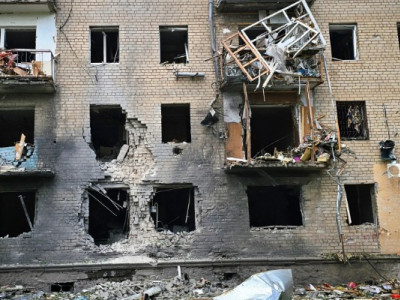
And Putin’s criminal war of aggression in Ukraine features widespread rape, abduction of children, and the mass execution of activists in occupied territories. But what is most obviously terroristic is the daily launch of drones and missiles targeting Ukrainian civilians.
I am writing this underground in Kharkiv, where the air raid sirens are sounding for the third time tonight. The Ukrainians shoot down most of the drones, but the missiles simply fall, explode, and kill, because Americans have chosen to deny them Patriot missiles.
This partly reflects the solidarity of terrorists: Trump’s emissaries were just in Moscow praising Putin's "goals." It is also a side effect of Trump’s doomed war of choice against Iran. The US has pointlessly fired munitions in the Middle East that might have saved lives in Ukraine.
Trump’s Iran war enables Putin’s Ukraine war.
And yet Trump’s war is extremely unpopular–and obviously lost. He stays in it, even as the US midterm elections approach, perhaps because he is hoping the Iranian regime will do him the favor of striking inside the US.
Then he can try to suspend elections or deploy more American troops in more American cities and remain in power indefinitely.
That is one way of wanting the terrorists to win:
fight a big war in the Middle East, deplete your own defenses, and hope for the worst. Iran might take the bait by launching a murderous action, or Trump could simply claim that it had.
Given all the provocations and lying and terror since 9/11, it would be foolish not to take this scenario seriously. And if it happens, the answer will be the same as it was in 2001: your freedom begins with your response. Above all, do not do the thing that the terrorist wants you to do.
From where I sit, in the dark hours of the early morning, I recall Ukrainians I saw last night, meeting underground for a public event, smiling, drinking wine, and talking about ideas, not doing what the terrorists want, not giving in and going along, but thinking for themselves about the future.
That is what Americans must do today, on this terrible anniversary. Do not be provoked; do not enter the mental world of the terrorist; think for yourself.
Only then can we hope to make this next quarter-century better than the last one.
This article originally appeared on Project Syndicate and is republished with permission from the copyright holder.
Timothy Snyder,
the inaugural Chair in Modern European History at the University of Toronto
- Last
- October, 23
-
-
-
-
-
-
-
-
-
-
-
-
-
-
-
-
-
-
-
News by day
24 of October 2026