UK Chancellor Rachel Reeves makes first official visit to Kyiv

"London – Kyiv: a route paved by our railway diplomacy to bring UK Chancellor of the Exchequer Rachel Reeves to the Ukrainian capital.
She is visiting our country for the first time in this role, continuing the tradition of strong partnership between Ukraine and the United Kingdom," Ukrzaliznytsia said.
Reeves arrived in Kyiv after participating in the Ukraine Recovery Conference held in Gdańsk, Poland. This was her first visit to Ukraine as Chancellor of the Exchequer.
In the capital, she met with Deputy Prime Minister and Minister of Digital Transformation Mykhailo Fedorov, as well as other members of the Ukrainian government.
The parties discussed the assistance already provided by the United Kingdom, as well as the next steps in bilateral cooperation. In particular, they addressed the new Defense Investment Plan and multilateral cooperation aimed at improving arms procurement and accelerating the delivery of military equipment. Special attention was also given to the use of high-precision offensive operations and modern strike capabilities.
"I have stated clearly, and the UK government has repeatedly emphasized, that we would be prepared to use not only the profits but also the frozen Russian assets themselves to support Ukraine in its war against Russia," Rachel Reeves said in a comment to Suspilne.
She noted that implementing such a decision would only be possible if a common position is reached among partners in the European Union and the G7. According to the Chancellor, if such an agreement is achieved, London is fully prepared to transfer those assets to Ukraine.
Reeves also spoke about the Defense Investment Plan, which is expected to be unveiled ahead of the NATO Summit. According to her, the document provides for a significant increase in defense spending, as well as more effective use of funds in line with current challenges and the evolving nature of modern warfare.
The Chancellor explained that new budget accounting rules allow the British government to treat capital expenditure differently. This is particularly important because most UK support for Ukraine is financed through capital spending, including the restoration of energy infrastructure damaged by Russian attacks and the procurement of military equipment.
Reeves also stressed that the United Kingdom has committed to increasing defence spending to 3% of GDP during the next parliamentary term and to 3.5% of GDP by 2034–2035. Defence spending has already increased from 2.3% to 2.6% of GDP, with the next target expected to be reached by April next year.
During the meeting, British and Ukrainian defense companies showcased advanced technologies already being used on the battlefield. According to the British Embassy, the participating companies alone have created more than 800 jobs in the United Kingdom.
In the 2026/27 financial year, the UK's non-military assistance to Ukraine will total £1.5 billion (approximately $2 billion). This funding comes in addition to the UK's annual military assistance of £3 billion, which London has pledged to continue providing until the end of the decade, or for as long as Ukraine requires it.
With British support, more than 28,000 Ukrainian households and businesses received uninterrupted electricity and heating throughout the winter. UK assistance has also helped protect approximately 25% of Ukraine's national energy infrastructure from Russian attacks.
During her visit to Kyiv, Rachel Reeves also honoured those killed since the start of Russia's full-scale invasion by laying flowers at the Wall of Remembrance near St. Michael's Golden-Domed Monastery.
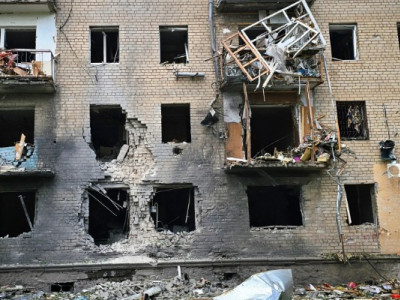
Reeves also visited the Kyiv-Pechersk Lavra, which sustained significant damage during a Russian attack in early June.
Earlier, the UK government confirmed guarantees for a £210 million loan to support stable supplies of enriched uranium from Urenco to Ukraine's nuclear power plants over the next two years.
The agreement was reached during a meeting between UK Prime Minister Keir Starmer and Ukrainian President Volodymyr Zelenskyi at Downing Street.
- Last
-
- June, 29
-
-
-
-
-
-
-
-
-
-
-
-
-
-
-
-
-
-
News by day
30 of June 2026