Ukraine Found a Cheap Answer to Shaheds. Ballistic Missiles Are the Next Challenge

Ukraine has learned how to counter large-scale Shahed attacks with relatively cheap interceptor drones, changing the economics of air defense. But ballistic missiles remain a fundamentally different problem — and the strikes of July showed just how exposed Ukrainian cities remain to this threat.
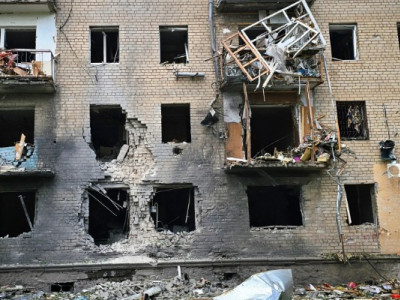
On the night of July 6, Russia launched 29 ballistic missiles at Ukraine alongside several hypersonic Zircon missiles. None of the ballistic targets were intercepted, and more than 20 people were killed in the attack on Kyiv. The strike came on the eve of the NATO summit, highlighting a problem that Ukraine has repeatedly raised with its partners: defeating drones is not enough. Europe also needs a sustainable missile-defense capability capable of confronting ballistic threats.
Shahed drones are relatively slow, fly at low altitude and are inexpensive enough to be engaged by low-cost interceptors and even conventional anti-aircraft weapons. Ukraine has demonstrated that this approach can achieve very high interception rates without spending millions of dollars on every target.
Ballistic missiles such as Iskanders and Kinzhals are a different category. They accelerate rapidly, follow steep trajectories and can reach their targets within minutes, leaving defenders very little time to react. Systems such as the American Patriot and the Franco-Italian SAMP/T are among the few capable of engaging them effectively.
The problem is availability. These systems are scarce, their interceptors are extremely expensive, and production cannot keep pace with demand. Ukraine therefore faces an uncomfortable paradox: it has developed increasingly efficient ways of dealing with cheap drones while having far fewer resources to defend itself against the missiles that pose the greatest threat to cities.
The figures from July illustrate the gap. During the July 2 mass strike, only 24 of 74 Iskander missiles were intercepted. Four days later, none of the ballistic missiles launched against Ukraine were stopped.
The shortage is particularly dangerous for cities such as Kharkiv, Zaporizhzhia and Dnipro, where the short distance from Russian launch sites leaves almost no warning time.
This is why Kyiv’s requests to its partners increasingly focus not simply on air defense, but specifically on missile defense.
President Volodymyr Zelenskyy has repeatedly emphasized that even existing systems cannot provide adequate protection without a reliable supply of interceptors. The problem is not merely the number of launchers available; it is whether enough missiles exist to keep those launchers operational during sustained attacks.
The scale of the challenge is enormous. Lockheed Martin produces roughly 600 Patriot interceptors annually, according to figures cited by Zelenskyy. That is insufficient for a war in which Russia can launch dozens of ballistic missiles during a single attack.
Europe is therefore beginning to look for an alternative to relying almost entirely on expensive American systems.
On July 13, Ukraine and nine other countries announced a coalition aimed at developing a European capability to protect against ballistic missiles. The objective is not simply another political declaration, but a system that could eventually be produced at scale and at a substantially lower cost.
The centerpiece of this effort is the Ukrainian Freya project, based on the Fire Point FP-7 interceptor family.
Its main advantage is intended to be economic as much as technological. Instead of building missile defense around a small number of extremely expensive interceptors, the Ukrainian approach seeks a cheaper system that could eventually be manufactured in much larger quantities.
European defense companies are already becoming involved. Germany’s Hensoldt, Sweden’s Saab, Diehl Defence, and France’s Thales and Safran are among the companies participating in the broader effort.
Ukraine contributes something that cannot simply be purchased or reproduced in a laboratory: four years of direct combat experience against Russian ballistic and hypersonic weapons.
That experience matters. Ukrainian engineers and military specialists have been forced to adapt their systems under constant attack, learning how Russian missiles behave, how their trajectories can be tracked and where existing defenses fail.
At the same time, Washington has agreed to allow Ukraine to produce Patriot interceptors under license. This creates two parallel paths: continuing to expand access to the highly capable but expensive American system while developing a cheaper European-Ukrainian alternative.
The significance of Freya lies less in the existence of another missile-defense project than in the economic model behind it.
The war has demonstrated that even the most sophisticated defensive system becomes ineffective if there are too few interceptors to sustain it. A missile that costs millions of dollars cannot be an economically sustainable response to every threat when the attacker can produce large numbers of missiles and drones.
Ukraine’s experience with interceptor drones against Shaheds offers a different lesson: defense becomes much more sustainable when the cost of interception is brought closer to the cost of the incoming threat.
Ballistic missiles cannot simply be countered with the same technology. But the principle can be transferred — build a dedicated interceptor that is sufficiently capable while remaining cheap enough to manufacture in large quantities.
For Europe, this is increasingly becoming a continental security issue rather than a purely Ukrainian one. Russia’s missile arsenal represents a threat to the entire European security architecture, while the war in the Middle East has demonstrated how quickly missile warfare can put pressure on existing stocks of interceptors.
Europe therefore has a choice: continue depending on a limited supply of expensive American systems or begin developing its own layered missile-defense capability.
Ukraine’s experience provides a possible blueprint.
The lesson is increasingly clear: air defense can deal with the cheaper and less sophisticated part of the threat, but ballistic missiles require a dedicated missile-defense layer. Ukraine has spent four years learning this distinction under fire. Europe is now beginning to turn that experience into an industrial project of its own.
Read the full article by Valentyn Gladkykh, political analyst, expert at the United Ukraine Think Tank
- Last
News by day
16 of August 2026