Our website uses cookies to provide your browsing experience and relevant information. Before continuing to use our website, you agree & accept our Cookie Policy & Privacy.
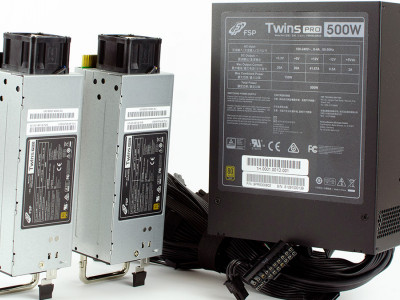
In the past, when the sky was bluer and the grass was, ahem… more bumpy, when many now defunct companies still existed, and there were still no large number of Chinese brands and OEM products, there were noticeably more unique things in the segment of computer components. Unification and globalization have led to the fact that the lion’s share of modern products, although glowing in 16.7 million shades, are actually gray. Over the past 10-odd years, of truly unique things I can only recall the Thermaltake Engine 17/27 processor coolers, where the fan itself is a radiator; SRO CoolerMaster Sub-Zero with Peltier elements; cases in the shape of yachts and locomotives from Lian Li; and ‘double’ ASUS GTX 760 ROG Mars graphics card. And also power supply units of the FSP Twins Pro series, which are also ‘double’. The unique feature of FSP Twins Pro 500W, which is reviewed today, is that in fact we have a consumer power supply unit in the usual ATX format in front of us, which fits into ordinary PCs and workstations without problems, but with a purely server feature – redundancy.
Inside the PSU there are 2 separate modules that power the system at the same time. In case of failure of one of them, the second takes over the entire load instantly, and even without rebooting the system.
Second, look at the table of contents – there is a ‘software’ section, and it’s in the power supply. Undoubtedly, this is not the first PSU with the possibility of tracking, so to speak, well-being, but it is also a plus based on a combination of factors. So, for innovations, FSP engineers receive loyalty points straight from the start, and we are now moving on.
Server power supplies made in U-formats, like all truly server power supplies, are not cheap. In addition, it is not interesting to a simple consumer due to incompatibility with ordinary hardware, noise level, inconvenient form factor, etc. FSP has brought some of these points to a look suitable for home use and not only, but the FSP Twins Pro cost quite a bit.
Read also:
The 500-watt, 700-watt, and 900-watt models have a suggested retail price of $450, $560, and $670, respectively.
Of course, there are separate modules available for sale. It costs $210 for the 500-watt version. But there are problems with the availability of modules in Ukraine – they are simply not available for sale. According to the FSP representative, they will definitely appear in the near future.
When speaking about the price, of course, the thought creeps in to buy a very cool PSU but without redundancy as an alternative. And at this point, I would like to be happy about the presence of a local FSP representative office, because the real price is equal to the recommended one. But the Seasonic Prime TX 750, which is supposed to cost $220, actually costs UAH 12,000.
There is another way to look at the price tag. On the one hand, of course, it is expensive for 500 W, even if it is 2x 500 W. On the other hand, not too much more expensive than ordinary top-end units, although such parallels are not very appropriate. In my opinion, the FSP could have been even greedier due to the lack of competition, if they wished to. In general, I would say that the price tag is quite adequate.
A box with a handle is practically a certain sign of if not of ‘decent’, but at least of interesting hardware.
Boxing is really big. It looks very convincing against the box of an ordinary such an inexpensive PSU.
I got the junior 500-watt version. Surprisingly, there are models with a capacity of up to 900 W, where each module ‘carries’ 930 W. But its dimensions are very small.
There are more boxes inside the outer box. The unit itself and the modules are packed separately, the protection is good.
Brief electrical specifications are given on the box of the unit itself, as well as the number of cables/connectors (pay attention to the 3.3 V line, we will return to it later).
The delivery set of FSP Twins Pro 500W includes:
Cable retainers do what their name suggests.
The PSU received a non-modular cable connection structure. They leave the case altogether. The number of cables/connectors is as follows:
As for 500 watts of power, it is very rich. Especially 4 connectors for powering video cards and a couple for the processor. And this is great, because many modern boards require more than one connector per processor, and often 3 for a video card.
Read also:
But I’d rather have the length of the cables some 5-10 cm longer. In PCI-E Power has 450 mm to the first connector, the main power strip has 480 mm, and in EPS12V it is 600 mm.
However, the crossing of the veins does not cause complaints. Most of the cores have noble 18 AWG, even 16 AWG is found in the main 24-pin block. The section before and after the first connector on the connector branch is the same.
Most of the contacts are not gilded, but there were a couple of gilded contacts in the 24-pin power block. One of them is the PS-ON wire for turning on, the second is one of the wires of the 12 V line.
The FSP Twins Pro 500W is not about design. This block has an exclusively utilitarian purpose, beauty has nothing to do with it. Of course, there is no backlight. It is completely black, there are no decorations. To put it bluntly, the appearance is simply boring.
Here comes an unusual complaint: the PSU is somehow strangely painted. And I’m not talking about the lack of paint inside, which will be discussed in the corresponding section. The body is very greasy, it leaves dirty marks. Usually one piece of paper is enough for me to wipe 2-3 samples, and one Twins Pro took 4 pieces. In general, there were no such problems with FSP power supplies, they are decently painted, including inexpensive ones.
The front panel is fully covered with perforation. The back, as you can see, is completely missing.
A PSU filled with modules already looks more interesting. And it also gains a very noticeable weight, almost 3 kg. This is quite a lot for a block in the usual ATX format. By the way, it has dimensions of 150×86×190 mm, that is, it is quite deep.
The cooling system is interestingly implemented. FSP Twins Pro 500W takes air from inside the system unit, pulls it through each module separately and throws it back. At the same time, the noise of the fans is muffled because they are deep inside.
The PSU is equipped not only with the usual protections, but also with protection against a fool. Modules can be hot-swappable, but only with power removed from the module being replaced. The module is removed only by pressing the lever, and the body of the plug does not allow it to go down all the way.
The diode on the back is bright green if everything is fine. In case of problems, red flashes and a strong beeping sound appears, which signals this.
A sticker with electrical parameters is located on the bottom in a fashionable way. FSP Twins Pro 500W supports the full range of input voltage, that is, it does not require a power stabilizer and perfectly withstands sharp dips and jumps in input voltage.
Read also: ASUS ROG Rapture GT-AX6000 EVA Edition Review: Powerful Gaming Router
Following the rule of thumb for decent PSUs, there is only one 12 V line, and all 100% of the power can go to it. This is 41.67 A of current, that is, 500 W of power. Up to 20 A of current can be allocated to the secondary lines of 3.3 V and 5 V, but no more than 130 W of power in total. There is also a -12 V line with a power of 6 W.
On the power module itself, the specifications are different. In fact, they only have line 12, which means that the DC-DC converter for 3.3 V and 5 V is in the main case. Each module claims 43.3 A of current, which is 520 W of power. FSP could safely call it Twins Pro 520W. By the way, the 700- and 900-watt versions also have a surplus.
T he first thing you see inside the FSP Twins Pro 500W is a few guides. They are quite large, and in fact FSP could have limited themselves less in the dimensions of the module.
In the front part there is a pair of connectors through which the modules provide 12 V voltage and exchange data for monitoring.
The modules output only 12 V. The DC-DC converter is located on the daughter board in the main case. The white rectangles most likely act as a dielectric spacer. The fact that this is not a thermal pad is hinted at by the thickness of 5 mm. Due to such a thickness, heat is almost not transferred.
The module itself is assembled using the stud-groove system from two L-shaped halves. It was easy to assemble them, but it is impossible to disassemble them without damage, since the steel is 0.3 mm. Therefore, let’s get a little inspiration from the photo of the board at Tom’s Hardware.
Despite the very dense layout, although not as dense as the FlexGuru Pro, the topology is essentially no different from a conventional power supply. The FSP Twins Pro 500W is based on a half-bridge topology with a resonant LLC converter, like the lion’s share of modern PSUs.
The input filter is complete, there is also an NTC thermistor and a relay to protect against large inrush currents.
The main capacitor pair is Nichicon with characteristics of 105°C, 420 V, 150 µF each. 300 μF somehow feels not enough for 500 watts. In addition, the block needs a considerable hold time to compensate for the drawdown when switching the load on one module. However, as practice has shown, this is enough for hot replacement of modules without rebooting, including in full mode.
Read also: TECNO Camon 19 Review: A Stylish Smartphone With a Powerful Camera
Secondary capacitors are almost all solid-state, resistant to high temperatures. There are not many electrolytics, all from Chemi-Con, all 105-degree, and also from the ‘swag’ KY and KZH series .
Cooling is handled by a 40mm Protechnic Electronic MGT4012ZB-W28 propeller based on a durable double bearing, aka double rolling bearing. The most reliable bearing of all, and also the most stable at high speeds. Hardly anything different could be found here, con