From Dominating The Black Sea To Troop-Supply Problems: How Russia Is Losing Crimea’s Military Significance

Russia may lack the resources to lift the collapsed bridge arch from the bottom of the Kerch Strait. Foreign specialized equipment was used during the crossing’s construction, but foreign companies are now unlikely to agree to work in a combat zone.
However, Moscow’s main problem isn’t so much repair as the disruption of military logistics. Despite Putin’s claims that the facility is “purely civilian,” the Kerch Bridge remains an important element of supplying the Russian army.
“A purely civilian facility” — that’s what Putin called the Kerch Bridge after the series of Ukrainian strikes. The Kremlin leader claims that military equipment, ammunition, and fuel supposedly haven’t been transported across the crossing for a long time. However, Russia’s own Ministry of Defense had published footage of military equipment moving across the bridge.
Since 2014, Moscow has consistently turned occupied Crimea into a military staging ground: modernizing airfields, restoring Soviet-era military facilities, strengthening its naval presence, and deploying new units. As early as 2016, Reuters journalists identified at least 18 operational military facilities on the peninsula.
In February 2022, it was precisely from occupied Crimean territory that Russian forces launched their advance into southern Ukraine. Putin ordered the construction of a road and rail bridge across the Kerch Strait as early as March 19, 2014 — practically immediately after Crimea’s occupation. Building the 19-kilometer crossing cost the Russian budget nearly 228 billion rubles.
Russian propaganda presented the opening of the bridge’s road section in May 2018 as a historic Kremlin achievement. Within a few years, the crossing had become one of the key logistics arteries for Russia’s invasion of Ukraine.
Russia itself provided evidence of the bridge’s military use. On February 16, 2022, eight days before the full-scale invasion, Russia’s Ministry of Defense published footage of a train carrying tanks, infantry fighting vehicles, and self-propelled artillery crossing the bridge.
Besides the Kerch Bridge, Russia uses a ferry crossing and an overland corridor through occupied territories of southern Ukraine to supply its grouping in Crimea. However, both routes have significant limitations. Some ferries have been damaged by Ukrainian strikes, and their operation depends on weather conditions. In addition, debris from the collapsed Kerch Bridge arch has blocked the shipping channel between the Azov and Black Seas.
The overland route through occupied Mariupol, Berdiansk, and Melitopol is considerably longer and also vulnerable to Ukrainian strikes.
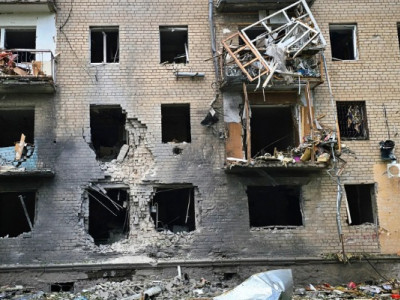
Ukraine has struck the Kerch Bridge multiple times. The crossing was damaged in October 2022, July 2023, and June 2025. However, the most extensive destruction occurred in November 2026. Following a series of Ukrainian strikes on November 17, the road span and the arch over the shipping channel collapsed. Two days later, the bridge’s rail section was struck.
What role does this Black Sea crossing play in the war against Ukraine, and why do the consequences of strikes on the Kerch Bridge extend far beyond Crimea? These questions were answered on FREEДOM TV channel by:
OLEKSANDR MUSIIENKO: Crimea Is Ceasing To Be A Reliable Operational Rear For The Russian Army
— The strike on the Crimean Bridge itself was planned so carefully and precisely that it managed to take the bridge’s road section out of operation for an extended period. But this isn’t the final act yet.
There’s the bridge’s rail section, which has also been damaged. Most likely, the occupiers will repair it, and it could be restored faster than the road section.
It’s already being recorded that Russian logistics are reorienting toward the overland route through occupied Ukrainian territory. But the enemy faces serious problems there too, since a number of transport facilities there have also come under strike.
We can discuss endlessly how much cargo passed over the Crimean Bridge — more or less. But what matters most is that the enemy has lost logistical flexibility. It’s now forced to rely on a limited number of routes.
The Russians can no longer structure their logistics the way they used to, splitting the load between the overland corridor and the Crimean Bridge.
And this has not just tactical and operational, but already strategic, consequences.
When we talk about turning Crimea into a military hub, we need to understand what it was all done for. Russia was pursuing two goals.
The first was establishing de facto dominance in the Black Sea. The second was using Crimea for what we saw in 2022 — the full-scale invasion of Ukraine. For this, Russia accumulated significant resources on the peninsula.
The Russians restored military towns that hadn’t been used since the Soviet Union’s collapse, redeploying personnel there. Since existing military facilities weren’t enough, servicemembers were housed in sanatoriums, boarding houses, and the like.
Crimea is a massive logistics base. Russia viewed it as an operational rear, where resources could be accumulated to support its forces in the Kherson direction and in the occupied part of Zaporizhzhia region.
Disrupting transport links to Crimea could significantly complicate supplying Russian forces in southern Ukraine. The Russians will try to compensate through the overland corridor, but the problems will be noticeable.
If we’re talking about the two strategic goals Russia pursued from the start of its unlawful aggression, we’re talking specifically about military objectives, not political or symbolic ones.
What can Russia do now?
It can’t establish dominance in the Black Sea. Ukraine’s Defense Forces have acted so effectively that Russia is forced to hide the remnants of its Black Sea Fleet in Novorossiysk. But we see that Novorossiysk is also periodically struck by Ukraine’s Defense Forces.
Russia also can’t use Crimea fully to carry out its aggressive military plans. Its logistics are under strike, and we see the intensity of attacks on military facilities on the occupied peninsula.
Thus, Russia’s ability to use Crimea as a reliable military and logistics base for its forces in southern Ukraine is being significantly reduced.
ANDRII RYZHENKO: Russia Will Need At Least One To Two Years To Restore The Crimean Bridge
— The Crimean Bridge is Putin’s project. He dreamed about it long before Crimea’s occupation in 2014. The bridge was built and opened with great pomp. Until 2022, before Russia seized the Azov Sea coast, it was the main transport artery connecting Russia with occupied Crimea.
It’s a kind of symbol of the Russian Federation. An enormous amount of resources was spent on building the bridge. Putin personally opened it. Significant resources also went toward guarding the facility.
That’s why I believe the strike on the bridge, timed before the trilateral summit of the leaders of the United States, China, and Russia, was tied to that date.
It somewhat dampened the Russian delegation’s enthusiasm, since Russia’s demands at the talks on a possible end to the war were so fantastical, as if it had already captured most of Ukraine’s territory and kept advancing. I think the operation was aimed, in part, at this too.
The second important point is the disruption of logistics. Even after the overland corridor to Crimea opened, a large volume of cargo continued being transported across the bridge, by both road and rail.
The third point is the blocking of the Kerch-Yenikale Canal, through which shipping takes place, including from the Azov Sea ports seized by Russia, officially closed by Ukraine’s government. Products that Russia is effectively stealing from Ukraine are also shipped out through these ports.
So three main consequences of the strike can be identified. But I consider the symbolic, informational-psychological, and ideological significance of this operation to be the most important.
The ferry crossing, which was the main means of connection between Kuban and Crimea before the bridge was built, operated unstably even during summer. When strong winds picked up, the crossing would stop operating. This happened every year.
In the autumn-winter period, weather conditions worsen. Winds significantly intensify in the area of the Kerch Strait and the Taman Peninsula, making the ferry crossing extremely unreliable.
In addition, heavy military equipment is typically transported by rail. So using alternative connection methods is a rather unreliable solution to a serious logistics problem.
As a result of damage to the arch structure, part of the road surface collapsed, according to available data. The remains of the structure ended up on the seabed, obstructing shipping.
It’s currently difficult to assess the extent of the damage, since the structure could have deformed significantly. I think the tugboats and diving vessels present there are studying the situation and assessing how long clearing the debris will take.
I think it’ll take weeks, and most likely months, to clear the channel and restore shipping. As for restoring the bridge itself, we could be talking about at least one to two years, under the most favorable circumstances for Russia.
Clearly, the Russians are currently studying the situation, after which a plan will be developed for clearing the channel to restore both civilian and military shipping.
Blocking the channel also limits Russia’s ability to redeploy additional ships from other regions.
Russia has very limited capacity to strengthen its air defense system in the Crimean Bridge area, especially since Ukrainian forces have regularly attacked it. Restoring air defense has had to be done by redeploying assets from other directions, which is also undesirable for Russia.
Ukraine’s security and defense forces, for their part, continue studying the situation.
I think Russia will continue encountering difficulties restoring transport links and shipping in the Crimean Bridge area.
DMYTRO PLETENCHUK: Block
- Last
News by day
26 of November 2026