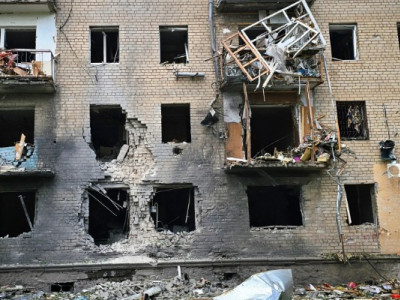
Grass and leaves on plates: Tokyo demonstration highlights humanitarian crisis in Oleshky

Activists also displayed signs in Japanese detailing the number of people remaining under occupation and the town's humanitarian situation.
According to the community, approximately 2,000 people remain trapped in Oleshky, including children and elderly residents.
Organizers urge Ukrainian communities abroad to join ongoing rallies and petition their host governments to push for diplomatic assistance in evacuating civilians from the blockaded town.
Similar events have taken place in other global cities. Ukrainians recently held demonstrations in Warsaw, Vienna, Milan, and Vancouver to draw attention to the plight of residents of occupied towns.
Background
The Ministry of Foreign Affairs of Ukraine constantly draws international attention to the severe deterioration of the humanitarian situation in certain areas of the temporarily occupied Kherson region due to crimes by Russian occupiers, who grossly violate international humanitarian law.
The situation in Oleshky, Hola Prystan, Stara Zburivka, and Nova Zburivka in the Kherson region is of particular concern, as the basic conditions needed to meet residents' needs, including children's, are entirely absent. Russian occupiers artificially block people from leaving and create obstacles to the supply of basic consumer goods, food products, and medicines.
The population has dropped from 40,000 to around 6,000 people, and in the city of Oleshky specifically, from 24,000 to roughly 2,000.
In May, the Ukrainian side held negotiations regarding the urgent humanitarian evacuation of civilians from temporarily occupied settlements in the Kherson region, where active fighting created a critical situation. This specifically concerns Oleshky, Hola Prystan, Stara Zburivka, and Nova Zburivka, where people remain without food, drinking water, and medicine.
Earlier, Minister of Foreign Affairs Andrii Sybiha declared a critical humanitarian situation in temporarily occupied Oleshky, Kherson region. According to him, civilians, including children, remain without sufficient food, medicine, clean water, electricity, and medical care. He called on the UN, the ICRC, and other international organizations to ensure humanitarian access and safe evacuation of people.
Additionally, the All-Ukrainian Council of Churches and Religious Organizations called on Pope Leo XIV and international organizations to facilitate humanitarian assistance and the evacuation of residents.
Ukrainian Parliament Commissioner for Human Rights Dmytro Lubinets stated that Russia has consistently refused to confirm its readiness to organize a humanitarian mission to evacuate civilians from Oleshky.
On October 4, guardsmen from the 11th Brigade of the National Guard of Ukraine named after Mykhailo Hrushevskyi and the 34th Kherson Regiment conducted a second successful operation delivering humanitarian aid to Oleshky.
As Rubryka reported, approximately two thousand residents of Oleshky have lived without food, drinking water, or medicine under strict Russian occupation control since April 2026. The town fell under occupation in the first days of the full-scale invasion. Since spring 2026, the situation has deteriorated sharply: residents face severe shortages of supplies while Russia blocks routes to Ukrainian-controlled territory, leaving two thousand people under siege.
Rubryka spoke with Oleksandr Pavlichenko, executive director of the Ukrainian Helsinki Human Rights Union, about potential leverage options against Russia and similar historical precedents from the Russo-Ukrainian war.
- Last
- October, 09
-
-
-
-
-
-
-
-
-
-
-
-
-
-
-
-
-
-
-
News by day
10 of October 2026